
If your vision system measures parts, the lens can be the largest error in the system. A standard lens sees in perspective, so a part that sits a little closer to the camera looks larger and measures larger. A telecentric lens removes that error. This guide explains when the difference matters, and how to choose the right telecentric lens for a gauging station.
Why a standard lens mis-measures
A standard (entocentric) lens collects light in a cone. Objects near the lens fill more of that cone and appear bigger; objects further away appear smaller. Magnification therefore depends on distance.
Take a 25 mm lens at 300 mm from a part. Its magnification is 25 / (300 − 25) = 0.0909. Move the part 1 mm closer and the magnification becomes 25 / 274 = 0.0912, about 0.36 % larger. On a 50 mm wide part, that is an error of 0.18 mm, larger than many tolerances.
The same effect causes three practical problems:
- Height variation. Parts that are not perfectly flat, or that sit on a conveyor with play, measure differently from shot to shot.
- Side walls. The lens sees the sides of holes and edges, so a bore looks narrower at the bottom than at the top.
- Position in the field. Near the edge of the image, the lens looks at the part at an angle, which shifts edges outward.
If you are not sure whether your set-up suffers from this, the focal length guide shows how to compute the magnification of a standard lens at your distance.
How a telecentric lens works
A telecentric lens has an aperture placed at its focal point, so it only accepts rays that travel parallel to the optical axis. Every point of the part is imaged by the same parallel bundle of light, whatever its distance. As long as the part stays within the depth of field, its image keeps the same size.
How well a lens does this is given as its telecentricity, an angle in degrees. A value below 0.1° means a 1 mm height change moves each edge by less than about 0.002 mm, some fifty times less than the 0.09 mm each edge moves with the standard lens in the example above.
Choosing the magnification
The magnification of a telecentric lens is fixed, so the choice works backwards from the field of view:
A 2/3-inch camera with a sensor 8.45 mm wide gives these fields:
| Magnification | Field of view (width) | Object pixel at 3.45 µm |
|---|---|---|
| 0.3x | 28 mm | 11.5 µm |
| 0.5x | 17 mm | 6.9 µm |
| 0.8x | 10.6 mm | 4.3 µm |
| 1x | 8.45 mm | 3.45 µm |
| 2x | 4.2 mm | 1.7 µm |
Pick the highest magnification whose field still covers the part plus its positioning margin. Then check whether the object pixel is small enough. A common rule for gauging is that the tolerance should span at least ten pixels, which the resolution calculator below lets you check.
A worked example
A connector housing is 12 mm wide, arrives within ±1 mm of its nominal position, and its width tolerance is ±0.05 mm. The field must therefore be at least 14 mm wide. With an 8.45 mm sensor that allows a magnification of up to 8.45 / 14 = 0.6x, so 0.5x, with its 17 mm field, is the practical choice.
At 0.5x each pixel covers 6.9 µm of the part, and the 0.1 mm tolerance band spans about 14 pixels: enough for reliable gauging. With a standard 25 mm lens at 300 mm, the same housing would have to stay within about 0.2 mm of its nominal height to keep the perspective error under a tenth of the tolerance. Few conveyors or fixtures hold that.
Working distance and depth of field
A telecentric lens works at one distance. Each model has its own working distance, often between about 65 mm and several hundred millimetres, with a depth of field of a few millimetres or less around it. Higher magnification means less depth of field.
Here are four lenses from one 2/3-inch C-mount series, to show how these values move together:
| Specification | LS-SWH045X135W | LS-SWH05X110W | LS-SWH08X110W | LS-SWH075X220W |
|---|---|---|---|---|
| Magnification (x) | 0.45 | 0.5 | 0.8 | 0.75 |
| Working distance (mm) | 135 | 110 | 110 | 220 |
| Image-side F/# | 15.3 | 9.6 | 11.0 | 10 |
| Object-side telecentricity (deg max) | <0.1 | <0.1 | <0.1 | 0.2 |
| Image-side distortion (% max) | 0.7 | <0.1 | <0.1 | 0.05 |
| Numerical aperture NA | 0.01467 | 0.026 | 0.036 | 0.03746 |
| Object-side resolution (um) | 22.9 | 12.9 | 9.3 | 9.0 |
| Theoretical depth of field (mm) | 6.04 | 3.07 | 1.4 | 1.42 |
| Image-side MTF30 (lp/mm) | 60 | 80 | 80 | 90 |
| Outer diameter O.D (mm) | dia. 34 | dia. 34 | dia. 28 | dia. 35 |
| Total length TTL (mm) | 115.8 | 135.2 | 134.4 | 140.3 |
| Front filter thread | M32x0.5 | M32x0.5 | M25x0.5 | – |
| Price | $969.00 | $929.00 | $789.00 | $809.00 |
All 4 share: Mount C; Max sensor size (dia. mm) 11.0(2/3"). Values as printed in each product's data sheet; open a part for its drawing and full specifications.
Two rows deserve a closer look. The object-side resolution is the smallest detail the optics can separate on the part; compare it with your object pixel, because the lens, not the camera, may set the limit. And the theoretical depth of field is how far the part may move along the axis while staying sharp.
Lighting for telecentric measurement
For outer dimensions, edges and holes, a backlight gives the cleanest edges: the part is a dark silhouette on a bright field. A collimated backlight goes one step further. Its light is also parallel, so it matches what the telecentric lens accepts, edges get sharper and stray light from the sides of the part disappears.
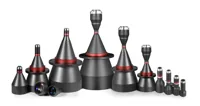
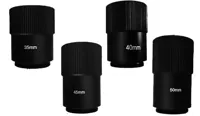
Some telecentric lenses are sold with a matching collimated light of the same field size:
- Sensor format
- 1.1"
- Mount
- C-mount
- Size
- Under 50 mm
For surface features, such as printed marks or scratches on a flat part, a coaxial light or a lens with a built-in coaxial port lights the part along the same axis the lens looks along. Browse the collimated lights and the full range of telecentric lenses, or filter them by magnification, working distance and sensor format in the lens finder.
A short selection procedure
- Measure the part and add the positioning margin: that is the field of view.
- Compute the magnification from the sensor width and pick the nearest available value that still covers the field.
- Check the object pixel against the tolerance (ten pixels per tolerance is a safe start).
- Check that the lens's image circle covers the sensor and that its object-side resolution is not coarser than the object pixel.
- Design the mount around the lens's working distance and depth of field.
- Add a backlight or collimated backlight for edges, or coaxial light for surface features.
- Calibrate once with a target to convert pixels to millimetres.
When the lens, camera and light are chosen, the system configurator checks the mount, sensor coverage and the rest of the station for you.
When you do not need one
Telecentric lenses are large, heavy, fixed and more expensive than standard lenses. A standard lens is the better choice when:
- the result is presence, orientation, colour or a code, not a dimension;
- the field of view is large (hundreds of millimetres);
- the part always sits at the same height, and the tolerance is loose compared with the perspective error.
If you are unsure, send us the part, the tolerance and the distances. Our machine-vision engineers will tell you whether a telecentric lens is needed and which magnification fits.
Questions
Can a telecentric lens zoom or focus at different distances?
No. A telecentric lens has one magnification and one working distance, with a small depth of field around it. The machine must hold the part at that distance, so design the mount and fixture around the lens rather than the other way round.
Why are telecentric lenses so large?
The front lens must be at least as wide as the field of view, because the lens only accepts light that travels parallel to its axis. A 50 mm field needs front optics wider than 50 mm, which makes large-field telecentric lenses heavy and expensive.
Do I still need to calibrate with a telecentric lens?
Yes, but the calibration holds across the depth of field. Measure a calibration target once to get millimetres per pixel and the residual distortion, and the result stays valid when parts sit slightly higher or lower.
Is a telecentric lens worth it for presence checks or code reading?
Rarely. Presence, orientation and code reading tolerate perspective, and a standard lens is smaller, cheaper and covers a wider field. Telecentric lenses pay off when the result is a dimension.