


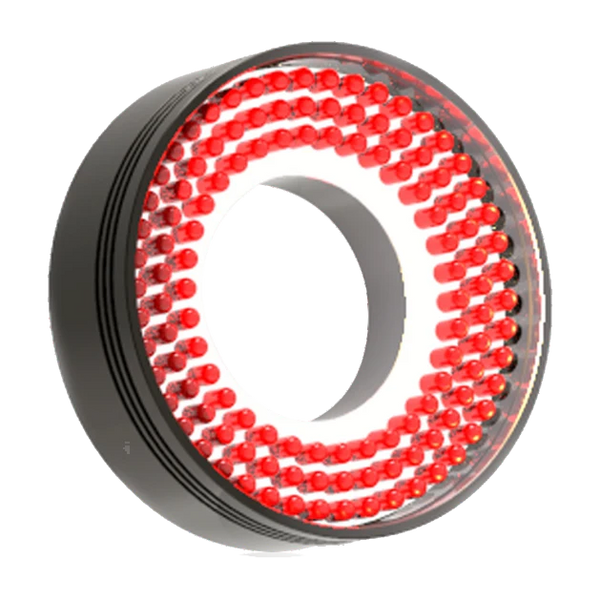
70 mm OD LED Ring Light, 45°
LS-RNG-0245
- Colour Red, Green, Blue, White
- Voltage 24 V
- Angle 45°
$219.00
In stock · 16 available
Lights
Ring lights mount around the lens for even, on-axis illumination of the inspection area. High-angle rings light flat parts brightly; low-angle rings graze the surface to pick out engraving, embossing, scratches and edges.
Shop by colour: Red ring lights · Blue ring lights · Green ring lights · White ring lights · Infrared ring lights · UV ring lights
Shop by diameter: 50 mm ring lights · 60 mm ring lights · 70 mm ring lights · 90 mm ring lights · 100 mm ring lights · 120 mm ring lights · 150 mm ring lights · 180 mm ring lights

LS-RNG-0245
$219.00
In stock · 16 available
LS-RNG-0244
$259.00
In stock · 13 available
LS-RNG-0242
$259.00
In stock · 17 available
LS-RNG-0237
$159.00
In stock · 15 available
LS-RNG-0236
$159.00
In stock · 12 available
LS-RNG-0241
$159.00
In stock · 13 available
LS-RNG-0240
$159.00
In stock · 9 available
LS-RNG-0239
$159.00
In stock · 13 available
LS-RNG-0235
$139.00
In stock · 16 available
LS-RNG-0234
$129.00
In stock · 13 available
LS-RNG-0233
$119.00
In stock · 14 available
LS-RNG-0217
$1,469.00
In stock · 12 available
LS-RNG-0216
$1,119.00
In stock · 12 available
LS-RNG-0215
$749.00
In stock · 12 available
LS-RNG-0214
$509.00
In stock · 9 available
| Compare | ||||||||
|---|---|---|---|---|---|---|---|---|
 LS-RNG-024570 mm OD LED Ring Light, 45° | Red, Green, Blue, White | 24 V | 45° | Standard | - | $219.00 | 16 in stock | |
|
LS-RNG-024460 mm OD LED Ring Light
| Red, Green, Blue, White | 24 V | 60° | Standard | - | $259.00 | 13 in stock | |
|
LS-RNG-024260 mm OD LED Ring Light
| Red, Green, Blue, White | 24 V | 60° | Standard | - | $259.00 | 17 in stock | |
|
LS-RNG-023750 mm OD LED Ring Light, 30°
| Red, Green, Blue, White | 24 V | 30° | Standard | - | $159.00 | 15 in stock | |
|
LS-RNG-023648 mm OD LED Ring Light
| Red, Green, Blue, White | 24 V | 30° | Standard | - | $159.00 | 12 in stock | |
|
LS-RNG-024150 mm OD LED Ring Light, 90°
| Red, Green, Blue, White | 24 V | 90° | Standard | - | $159.00 | 13 in stock | |
|
LS-RNG-024050 mm OD LED Ring Light, 75°
| Red, Green, Blue, White | 24 V | 75° | Standard | - | $159.00 | 9 in stock | |
|
LS-RNG-023950 mm OD LED Ring Light, 60°
| Red, Green, Blue, White | 24 V | 60° | Standard | - | $159.00 | 13 in stock | |
|
LS-RNG-023542 mm OD LED Ring Light
| Red, Green, Blue, White | 24 V | 65° | Standard | - | $139.00 | 16 in stock | |
|
LS-RNG-023435 mm OD LED Ring Light
| Red, Green, Blue, White | 24 V | 90° | Standard | - | $129.00 | 13 in stock | |
|
LS-RNG-023332 mm OD LED Ring Light
| Red, Green, Blue, White | 24 V | 70° | Standard | - | $119.00 | 14 in stock | |
 LS-RNG-0217268 mm OD Multi-Angle AOI LED Ring Light | Red, Green, Blue | 24 V | - | Arc / multi-angle | 17.5 W | $1,469.00 | 12 in stock | |
|
LS-RNG-0216198 mm OD Multi-Angle AOI LED Ring Light
| Red, Green, Blue | 24 V | - | Arc / multi-angle | 8.8 W | $1,119.00 | 12 in stock | |
|
LS-RNG-0215123.4 mm OD Multi-Angle AOI LED Ring Light
| Red, Green, Blue | 24 V | - | Arc / multi-angle | 5.5 W | $749.00 | 12 in stock | |
|
LS-RNG-021473 mm OD Multi-Angle AOI LED Ring Light
| Red, Green, Blue | 24 V | - | Arc / multi-angle | 4 W | $509.00 | 9 in stock |
A ring light mounts around the lens or just above the part and lights it from all sides at once, so shadows cancel and the light stays centred on the camera axis. It is the usual starting light for a new inspection. The choices that matter are the illumination angle, the working distance, the diameter and the colour.
Ring light angles are given between the light ray and the horizontal plane of the part. The angle decides whether the part looks bright or dark:
Lensed rings narrow the beam (for example 14-32°) to throw more light at a longer distance; a diffuser plate, flat or cup-shaped where offered, softens the output on semi-gloss parts.
The angle only works at the distance it was designed for. As a guide, one of the ranges here lists these working distances by angle:
| Angle | Working distance |
|---|---|
| 0° | 5-20 mm |
| 30° | 10-100 mm |
| 45° | 20-150 mm |
| 60° | 30-300 mm |
| 90° | 50-500 mm |
Check the stated best working distance of the model you pick. For a bright-field ring, a larger diameter at the same distance gives a softer, more even light; for a low-angle ring, the inner diameter must be larger than the part so the light reaches its edges. If the ring mounts on the lens, the inner diameter must clear the lens body and its field of view.
A ring light on a flat shiny part produces a reflected ring of LEDs. Options: tilt to a lower angle so the reflection misses the lens, use a polarized ring with a polarizer on the lens, or change the light type. Flat mirror-like parts suit a coaxial light; curved or crinkled shiny parts suit a dome light.
Most rings run on 24 V DC through a light controller. Rings with an internal or in-line driver dim with an analog voltage, and versions with a trigger input can be pulsed above their continuous rating to freeze moving parts. Check the connector (flying leads, M12 or a small 3-pin plug) and, for wet areas, an IP65 to IP69K rating.
| Parameter | Range in this category |
|---|---|
| Outer diameter | From about 20 mm to over 700 mm; most between 50 and 250 mm |
| Illumination angle | 0, 15, 30, 45, 60, 75 and 90°, plus special angles from 10 to 85° |
| LED rows | 1 to 9 |
| Colours | White, blue 455/470 nm, green 520-530 nm, red 625/660 nm, IR 730/850/940 nm, UV 365-405 nm |
| Supply | 24 V DC |
Common sizes: 50 mm, 70 mm, 90 mm, 120 mm and 150 mm ring lights. By colour: white, red, infrared and UV ring lights.
Ring light or dome light?
A ring light is directional and leaves texture visible; it suits matte parts and,
at a low angle, surface relief. A dome light is diffuse from every direction and removes glare on curved shiny parts.
What does the angle number mean?
It is the angle between the light ray and the part plane. 90° shines
straight down; 0° shines across the surface.
Do I need a diffuser?
On semi-gloss parts or at short distance a diffuser hides individual LED spots. On
matte parts at a longer distance a clear or lensed ring gives more light.
How do I match it to the lens?
Start from the field of view and working distance set by the
lens focal length, then
configure the system to pick a ring that fits that distance.
